 +86-13925515590
 kleinma@aliyun.com

Cover Glass for Outdoor Displays: What Should OEM Manufacturers Consider?

Why Outdoor Displays Need Different Cover Glass
An outdoor display may look similar to an indoor touchscreen, but the glass in front of it operates in a much less controlled environment.
Direct sunlight, rain, condensation, dust, temperature changes, fingerprints, cleaning, and accidental impact can all affect the display surface.
For this reason, cover glass for outdoor displays should be selected according to the complete operating environment rather than simply choosing a thicker piece of glass.
The display system also matters. A public information kiosk, EV charging station, outdoor industrial HMI, transportation terminal, and digital signage display may require different combinations of glass, coatings, printing, and mechanical processing.

1. Sunlight Readability Starts With the Front Glass
Direct sunlight is one of the biggest challenges for outdoor displays.
Even when the LCD or other display module has sufficient brightness, reflections from the front glass can make the information difficult to read.
The cover glass for outdoor displays therefore needs to be considered together with:
- Display brightness
- Ambient illumination
- Glass transmission
- Surface reflection
- Surface haze
- Viewing angle
- Display contrast
- Optical bonding
A highly transparent glass is not automatically the best outdoor solution if its front surface produces strong reflections.
This is why optical performance should be evaluated on the complete display assembly rather than by looking at the glass specification alone.
2. AG and AR Solve Different Outdoor Display Problems
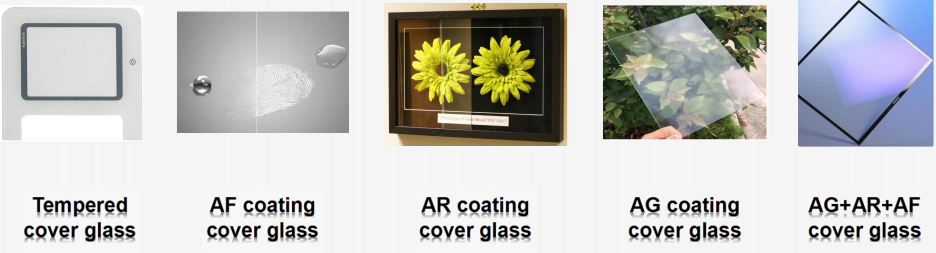
Outdoor display projects often require a discussion about anti-glare (AG) and anti-reflective (AR) treatment.
They are related, but they are not the same solution.
Anti-Glare Glass
AG treatment changes the way light interacts with the glass surface and can reduce the visual effect of strong reflections.
This can be useful where the display is exposed to changing outdoor lighting conditions.
Anti-Reflective Glass
AR treatment is designed to reduce surface reflection and improve light transmission through the glass.
It can be useful when maintaining display contrast and image visibility under strong ambient light is important.
The correct solution depends on the display, viewing environment, brightness, and required optical performance.
For some projects, a combination of optical treatments may be considered.
3. UV Exposure Should Be Considered as Part of Outdoor Reliability
Outdoor displays are exposed to sunlight for extended periods.
UV exposure does not only concern the glass itself. The complete display construction can include coatings, printed layers, adhesives, optical films, seals, and other materials that may respond differently to long-term environmental exposure.
Therefore, outdoor display development should consider the complete front assembly.
Depending on the project, OEM engineers may need to evaluate:
- UV exposure
- Coating durability
- Printed ink stability
- Adhesive performance
- Optical changes
- Surface discoloration
- Long-term transmission
The required testing should be based on the actual outdoor environment rather than assuming that every outdoor display requires the same UV specification.
4. Temperature Changes Can Affect the Display Assembly
Outdoor equipment can experience large temperature changes between daytime and nighttime operation.
The issue is not simply whether the glass can tolerate a high or low temperature.
The complete assembly contains multiple materials with different thermal expansion characteristics.
These can include:
- Cover glass
- Display panel
- Touch sensor
- OCA or optical adhesive
- Metal housing
- Plastic components
- Sealing materials
- Printed layers
- Surface coatings
When these materials expand and contract differently, mechanical stress can develop within the assembly.
For outdoor applications, temperature cycling should therefore be considered during reliability evaluation.
The IEC 60068 environmental testing series includes methods for evaluating equipment under temperature, humidity, and other environmental conditions.
5. Humidity and Condensation Are Different From Simple Water Exposure
Outdoor displays can encounter rain and high humidity, but condensation can create another problem.
When a display surface or internal component becomes colder than the surrounding air, moisture can condense.
This can affect:
- Optical appearance
- Touch response
- Adhesive interfaces
- Coatings
- Printed areas
- Seals
- Internal electronic components
IEC 60068-2-30:2025, for example, defines a damp-heat cyclic test involving high humidity combined with temperature changes and conditions that can produce condensation.
For an OEM project, the cover glass for outdoor displays should therefore be considered as part of the complete sealed or semi-sealed display construction.
6. Glass Thickness Should Not Be Chosen by Size Alone
A common mistake is to select cover glass for outdoor displays thickness simply according to display size.
In practice, several factors influence the required thickness:
- Overall glass dimensions
- Unsupported span
- Mounting structure
- Edge support
- Impact requirements
- Equipment design
- Touchscreen structure
- Glass type
- Strengthening method
A large display with strong mechanical support may have different requirements from a smaller display mounted in an exposed public enclosure.
The correct thickness should therefore be determined from the mechanical design and expected loading conditions.
7. Chemical Strengthening Can Be Useful for Thin Outdoor Cover Glass
For projects that require relatively thin glass with improved mechanical performance, chemically strengthened glass can be considered.
This can be particularly relevant for:
- Outdoor touchscreens
- Industrial HMIs
- Public kiosks
- Transportation displays
- EV charging interfaces
- Portable outdoor equipment
The strengthening process, glass composition, thickness, dimensions, and edge design should be evaluated together.
Chemical strengthening is not a replacement for good mechanical design. Edge geometry, mounting stress, holes, cutouts, and installation conditions can still influence the reliability of the finished component.
8. Touchscreen Outdoor Displays Have Additional Requirements
Outdoor touchscreen equipment introduces another layer of complexity.
Users may interact with the display while:
- Wearing gloves
- Having wet fingers
- Exposing the screen to rain
- Using the screen under direct sunlight
- Cleaning the surface frequently
The cover glass therefore needs to work with the underlying touch technology.
Relevant considerations may include:
- Glass thickness
- Touch sensor structure
- Surface treatment
- Optical bonding
- Wet-touch requirements
- Glove-touch requirements
- Fingerprint resistance
- Water behavior on the surface
For touchscreen applications, it is usually better to validate the glass and touch assembly together instead of evaluating the cover glass separately.
9. AF Coating Can Help Frequently Touched Outdoor Displays
Outdoor touchscreen displays can accumulate fingerprints, dust, and oily residues quickly.
An anti-fingerprint coating can reduce the tendency of fingerprints and oils to remain highly visible on the surface.
This can be useful for:
- EV charging stations
- Ticketing kiosks
- Self-service terminals
- Outdoor industrial controls
- Transportation information displays
However, AF performance should be evaluated together with cleaning requirements.
A coating that performs well under normal indoor use may need additional validation when the display is exposed to repeated outdoor cleaning, moisture, dust, and physical contact.
10. Outdoor Cover Glass May Need Custom Printing
The glass surface is not always completely transparent.
Custom screen printing can be used for:
- Black borders
- Logos
- Icons
- Functional markings
- Button indicators
- Decorative graphics
- Sensor masking areas
For outdoor equipment, the printed area may also hide adhesive, display edges, mounting structures, or electronic components.
The print dimensions and position should be defined from the display drawing because even a small positional difference can become visible around a touchscreen or display opening.
11. Edge Processing Matters More When the Glass Is Installed Outdoors
Outdoor cover glass often forms part of a mechanical enclosure.
The glass may therefore require:
- Edge grinding
- Edge polishing
- Chamfering
- Rounded corners
- CNC machining
- Holes
- Slots
- Notches
- Custom cutouts
The edge design should match the housing and mounting method.
For example, a hole or cutout can create a local stress concentration, while an improperly supported edge can create additional mechanical loading.
This is why the finished drawing should define not only the glass size and thickness, but also the edge and mounting requirements.
12. Optical Bonding Can Improve Outdoor Display Performance
Some cover glass for outdoor displays can be optically bonded to the display or touch assembly.
Optical bonding can reduce the air gap between layers and may improve perceived contrast by reducing internal reflections.
It can also change the mechanical and environmental behavior of the display stack.
The bonding method, adhesive, glass, touch sensor, and display panel therefore need to be considered together.
For an outdoor project, optical bonding should be evaluated according to:
- Display structure
- Operating temperature
- Humidity
- Adhesive performance
- Optical requirements
- Repair requirements
- Manufacturing process
13. What Applications Use Cover Glass For Outdoor Displays?
Custom cover glass for outdoor displays can be used in many types of equipment.
| Application | Typical Considerations |
|---|---|
| EV Charging Stations | Sunlight, touch, impact, cleaning, AG/AR/AF |
| Outdoor Kiosks | Glare, touch, fingerprints, vandal resistance |
| Digital Signage | Optical clarity, reflection, large size |
| Transportation Displays | Weather, impact, readability |
| Outdoor Industrial HMI | Temperature, humidity, touch, chemical exposure |
| Parking Terminals | Sunlight, rain, fingerprints, mechanical durability |
| Smart City Terminals | Outdoor exposure, touch, printing, optical performance |
| Agricultural Equipment | Dust, moisture, cleaning, impact |
| Marine Displays | Humidity, salt exposure, optical performance |
These are starting points rather than fixed specifications. The final cover glass for outdoor displays should be developed around the actual equipment and installation environment.
14. What Should Be Included in a Cover Glass for Outdoor Displays RFQ?
For an OEM quotation, providing more than the glass dimensions can significantly improve the engineering discussion.
Useful information includes:
Glass
- Glass type
- Length and width
- Thickness
- Tolerance
- Required strength
- Shape
Optical Requirements
- Light transmission
- Reflection target
- Haze
- AG or AR
- Viewing environment
Surface
- AF requirement
- Scratch resistance
- Cleaning conditions
- UV exposure
Machining
- Holes
- Slots
- Cutouts
- Edge processing
- Corner radius
Printing
- Black border
- Logo
- Icons
- Print dimensions
- Print position
Assembly
- Touch sensor
- OCA/OCR bonding
- Display model
- Housing structure
- Sealing method
Environment
- Operating temperature
- Storage temperature
- Humidity
- Sunlight exposure
- Rain or water exposure
- Dust
- Impact risk
This information gives the glass manufacturer a much better basis for selecting the appropriate material, thickness, strengthening method, coatings, and processing.
Cover Glass for outdoor displays Is a System-Level Decision
The most suitable cover glass for outdoor displays cannot be selected by looking at glass thickness alone.
Sunlight, reflection, UV exposure, temperature, humidity, condensation, touch operation, cleaning, impact, coatings, printing, and mechanical mounting can all affect the final display.
For this reason, outdoor display glass should be specified as part of the complete display assembly.
The goal is not simply to make the glass stronger. It is to make sure the finished display remains readable, functional, and mechanically reliable in the environment where the equipment will actually operate.
Frequently Asked Questions
What’s the suitable type of cover glass for outdoor displays?
The appropriate glass depends on display size, mechanical requirements, optical performance, environmental exposure, and the required surface treatment. Chemically strengthened glass can be considered for applications requiring thin glass with improved mechanical performance.
Is AG or AR glass better for outdoor displays?
Neither is universally better. AG is primarily used to manage glare, while AR is designed to reduce surface reflection. The choice depends on the display brightness, viewing environment, and optical requirements.
Does cover glass for outdoor displays need UV protection?
The need depends on the complete display construction and expected solar exposure. UV performance should be evaluated together with coatings, adhesives, printing, and other materials in the display assembly.
Can cover glass for outdoor displays be chemically strengthened?
Yes. Chemical strengthening can be considered when the project requires improved mechanical performance while maintaining a relatively thin glass profile.
Can outdoor cover glass include AF coating?
Yes. AF coating can be used for frequently touched displays to reduce the visible effect of fingerprints and oily residues.
Can cover glass for outdoor displays be customized with printing?
Yes. Custom black borders, logos, icons, and other graphics can be screen printed according to the display drawing.
Can cover glass for outdoor displays be CNC machined?
Yes. CNC processing can produce holes, slots, notches, cutouts, and other custom geometries.
What information should I provide for an outdoor cover glass quotation?
At minimum, provide the glass dimensions, thickness, drawing, application, display type, expected environment, surface treatment requirements, and estimated quantity. More detailed information about temperature, humidity, sunlight, touch operation, and mounting can help with engineering evaluation.
Related Cover Glass Solutions
- Electronic Display Cover Glass
- Custom Cover Glass
- AG Cover Glass
- AR Coated Cover Glass
- AF Cover Glass
- Chemically Strengthened Cover Glass
- Touch Screen Cover Glass
- CNC Machining for Cover Glass
- Screen Printing for Cover Glass
- OCA Lamination for Cover Glass
Looking for custom cover glass for an outdoor display?
Send your drawing, dimensions, thickness, display structure, surface requirements, and expected operating environment for an OEM quotation.