 +86-13925515590
 kleinma@aliyun.com

Chemical Strengthened vs. Tempered Glass for Display Cover Glass: Which Should You Choose?

When selecting display cover glass, one of the most important decisions is how the glass should be strengthened. Two widely used approaches are chemical strengthening and thermal tempering.
The choice between chemical strengthened vs tempered glass depends on the required thickness, impact resistance, surface durability, edge strength, product geometry, and application environment.
For electronic devices, industrial displays, automotive interfaces, medical equipment, and other applications, choosing the right strengthening method can directly affect the reliability and service life of the finished display.
This guide explains the key differences between chemically strengthened glass and tempered glass, and how to select the right solution for your display cover glass application.
Chemical Strengthened vs. Tempered Glass: At a Glance
Both chemical strengthening and thermal tempering improve the mechanical performance of glass, but they use fundamentally different processes.
| Feature | Chemically Strengthened Glass | Thermally Tempered Glass |
|---|---|---|
| Strengthening method | Ion exchange | Rapid heating and cooling |
| Typical thickness range | Very thin to medium | Usually medium to thick |
| Thin-glass performance | Excellent | More limited |
| Surface compressive stress | High | High |
| Edge strength | Excellent when properly processed | Generally lower than surface strength |
| Complex shapes | Well suited | More challenging |
| Small holes / cutouts | Well suited before strengthening | Requires careful processing |
| Surface durability | Excellent | Excellent |
| Fragmentation behavior | Smaller fragments possible depending on design | Characteristic tempered fragmentation |
| Typical applications | Displays, touchscreens, portable electronics | Industrial, automotive, architectural and larger glass |
| Best suited for | Thin, precision display cover glass | Thicker impact-resistant glass |
The most important difference is simple:
Chemical strengthening is particularly effective when a display requires high strength while maintaining a thin and lightweight glass profile. Thermal tempering is often preferred when thicker glass and strong impact resistance are required.
What Is Chemical Strengthening Glass?
Chemical strengthening glass is produced through an ion-exchange process.
In a typical process, the glass is immersed in a molten salt bath. Smaller ions in the glass are exchanged with larger ions from the salt. This creates a layer of compressive stress near the glass surface.
The resulting compression helps resist cracks and mechanical damage.
A major advantage of chemical strengthening is that it can provide high mechanical performance without requiring the glass to become significantly thicker.
This makes chemically strengthened cover glass particularly suitable for modern electronic displays where thinness, weight, optical quality, and durability must be balanced.
Key advantages of chemical strengthening
- Excellent performance for thin glass
- High surface compressive stress
- Improved resistance to scratches and mechanical damage
- Strong edge and corner performance when properly designed
- Suitable for complex shapes
- Compatible with precision CNC processing
- Suitable for display cover glass and touch interfaces
- Can be combined with AR, AG and AF surface treatments
- Suitable for custom OEM dimensions
For applications where a thin display cover glass must withstand repeated handling and mechanical stress, chemical strengthening is often an effective solution.
What Is Tempered Glass?
Tempered glass, also known as thermal tempered glass, is strengthened through controlled heating followed by rapid cooling.
The process creates compressive stress at the surface and tensile stress inside the glass.
Compared with ordinary annealed glass, tempered glass provides significantly improved mechanical and thermal performance.
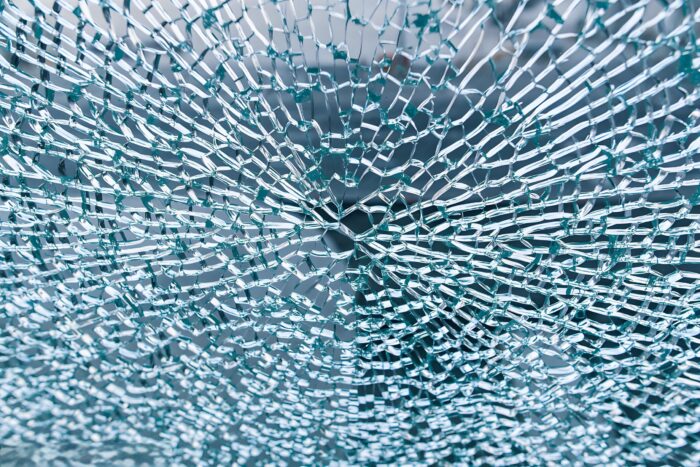
One of the defining characteristics of thermally tempered glass is its fragmentation behavior. When properly tempered glass breaks, it generally breaks into many smaller pieces rather than large sharp shards.
This characteristic makes tempered glass for display applications attractive when impact resistance and safety are important considerations.
Key advantages of tempered glass
- Improved impact resistance
- Good thermal resistance
- Suitable for thicker glass
- Well suited to industrial applications
- Useful for automotive and equipment displays
- Safety-oriented fragmentation behavior
- Cost-effective for many larger or thicker glass applications
However, thermal tempering requires the glass to pass through a heating and cooling process. This creates practical limitations when extremely thin glass, very small features, tight dimensional tolerances, or complex geometries are required.
Chemically Strengthened Glass vs. Tempered Glass: Key Differences
The differences between these two technologies become clearer when looking at the requirements of real-world display applications.
1. Glass Thickness
Thickness is one of the most important factors.
Chemical strengthening is particularly attractive for thin glass because the strengthening mechanism occurs through an ion-exchange layer near the surface.
This makes it suitable for applications requiring thin and lightweight display cover glass.
Thermal tempering generally becomes more practical as glass thickness increases because the glass needs to be heated and cooled uniformly during the tempering process.
For thin electronic displays:
Chemical strengthening generally provides greater design flexibility.
For thicker industrial glass:
Thermal tempering can be an effective option.
2. Impact and Damage Resistance
Both strengthening technologies improve resistance to mechanical damage, but their performance characteristics are different.
Chemical strengthening produces a compressive layer at the glass surface. Properly engineered chemically strengthened glass can provide excellent resistance to crack initiation and propagation.
This is particularly valuable for displays exposed to:
- Repeated touching
- Drops
- Edge impacts
- Mechanical vibration
- Bending stress
- Repeated handling
- Portable-device use
Thermally tempered glass also provides strong impact resistance, particularly when sufficient thickness is available.
For applications where damage resistance is the primary concern, the correct choice should consider not only the strengthening method but also thickness, glass composition, edge geometry, cutouts, holes, and the actual impact conditions.
3. Edge Strength
For display cover glass, the edges can be critical stress points.
A display may contain:
- CNC-machined edges
- Rounded corners
- Holes
- Notches
- Sensor openings
- Camera openings
- Touch-button openings
- Adhesive bonding areas
Chemical strengthening can be advantageous for these applications because the strengthening process can be performed after many precision glass-processing operations.
This allows manufacturers to produce complex display shapes while maintaining the required strengthening performance.
Thermal tempering is also possible for many customized glass designs, but the geometry and processing sequence must be carefully controlled.
For complex electronic cover glass, engineers should therefore evaluate edge strength and geometry, rather than comparing only the nominal strength of the glass.
4. Surface Strength and Scratch Resistance
Both chemically strengthened and thermally tempered glass can provide excellent surface durability.
However, strengthening should not be confused with a scratch-proof surface.
The final performance depends on:
- Glass composition
- Surface compressive stress
- Strengthening depth
- Surface treatment
- Coating system
- Processing quality
- Usage environment
For displays requiring additional optical or surface functionality, strengthening can be combined with coatings such as:
AR — Anti-Reflective
AG — Anti-Glare
AF — Anti-Fingerprint / Oleophobic
These treatments can be applied according to the requirements of the final display application.
5. Complex Shapes and Precision Processing
Modern display cover glass is rarely limited to a simple rectangular sheet.
OEM products may require:
- Custom dimensions
- Rounded corners
- Irregular outlines
- CNC machining
- Micro holes
- Camera openings
- Sensor windows
- Black borders
- Printed graphics
- Adhesive lamination
This is where chemical strengthening can offer significant design flexibility.
For example, a manufacturer may need a thin cover lens with several openings and a customized outline.
In this situation, the glass-processing sequence becomes just as important as the strengthening technology itself.
A qualified supplier should evaluate the complete process rather than recommending a strengthening method based only on the glass thickness.
6. Thermal Performance
Thermal tempering has an important advantage when the application involves elevated temperatures or rapid temperature changes.
Thermally tempered glass is commonly used where both mechanical and thermal performance are required.
Chemical strengthening can also provide good thermal performance, but the specific glass composition and application requirements need to be evaluated.
For equipment exposed to significant temperature variation, engineers should consider:
- Operating temperature
- Temperature cycling
- Thermal shock
- Heating elements
- Outdoor exposure
- Equipment enclosure design
The appropriate glass should be selected based on the complete operating environment.
Chemical Strengthening Glass vs. Tempered Glass for Display Applications
There is no single strengthening technology that is correct for every display.
The better approach is to match the strengthening method to the product requirements.
Chemical Strengthening Is Often Suitable For:
- Smartphones and portable electronics
- Touchscreen displays
- Industrial control panels
- Handheld equipment
- Medical electronics
- Thin display cover glass
- Camera and sensor windows
- Complex-shaped electronic cover lenses
- Lightweight electronic products
- Thin glass applications requiring high durability
Thermal Tempering Is Often Suitable For:
- Industrial equipment displays
- Automotive display components
- Larger display windows
- Machine interfaces
- Equipment requiring thicker protective glass
- Applications requiring thermal resistance
- Applications where safety fragmentation is an important consideration
The final selection should be based on the actual engineering requirements rather than simply choosing the strongest glass available.
How to Choose the Right Cover Glass Strengthening Method
When selecting cover glass strengthening, engineers and purchasing teams can use the following five-step process.
Step 1: Define the Glass Thickness
Start with the required thickness.
For example:
- Ultra-thin applications
- 0.7–1.0 mm applications
- 1.0–2.0 mm applications
- 2.0 mm+ industrial applications
If the product requires very thin glass with high mechanical performance, chemical strengthening should be considered early in the design process.
Step 2: Define the Impact Requirements
Determine how the glass will be used.
Consider:
- Drop height
- Impact frequency
- Object impact
- Edge impact
- Pressure
- Vibration
- Repeated touch
- Installation stress
The strengthening method should be selected based on actual use conditions.
Step 3: Evaluate the Glass Geometry
Check whether the cover glass includes:
- Holes
- Slots
- Notches
- Rounded corners
- Complex outlines
- Camera openings
- Sensor windows
- Decorative borders
Complex geometry can significantly influence the final mechanical performance.
Step 4: Consider Optical and Surface Requirements
Display cover glass is not only about mechanical strength.
The finished component may also require:
- High optical transmission
- Low haze
- Anti-reflective performance
- Anti-glare surface
- Anti-fingerprint performance
- Printed borders
- Black ink
- Touchscreen compatibility
Therefore, strengthening should be evaluated together with the complete optical and surface-treatment specification.
Step 5: Match the Glass to the Final Application
The final application determines the most appropriate solution.
For example:
Portable electronics → thin chemically strengthened cover glass
Industrial control panel → chemically strengthened or tempered glass depending on thickness and impact requirements
Large equipment display → thicker tempered or laminated glass may be appropriate
Precision electronic window → chemically strengthened cover glass can provide greater design flexibility
High-touch touchscreen → chemically strengthened glass with an appropriate surface treatment can be considered
Chemical Strengthened Cover Glass for Custom OEM Applications
For OEM display projects, strengthening technology is only one part of the specification.
A complete chemical strengthened cover glass solution may include:
- Custom glass composition
- Custom thickness
- Chemical strengthening
- CNC edge processing
- Drilled holes
- Notches and cutouts
- Rounded corners
- Silk-screen printing
- Black borders
- AR coating
- AG coating
- AF coating
- Optical bonding or adhesive lamination
- Custom packaging
For this reason, buyers should evaluate the supplier’s complete processing capability rather than comparing glass strength numbers alone.
Chemical Strengthened vs. Tempered Glass: Practical Selection Guide
The following simplified guide can help engineers begin the selection process.
| Requirement | Chemical Strengthening | Thermal Tempering |
|---|---|---|
| Very thin glass | ✓✓✓ | ✓ |
| High surface compression | ✓✓✓ | ✓✓ |
| Complex display geometry | ✓✓✓ | ✓✓ |
| Precision electronic cover glass | ✓✓✓ | ✓✓ |
| Thick industrial glass | ✓✓ | ✓✓✓ |
| Thermal resistance | ✓✓ | ✓✓✓ |
| Lightweight design | ✓✓✓ | ✓✓ |
| Safety fragmentation | — | ✓✓✓ |
| Portable electronics | ✓✓✓ | ✓ |
| Large industrial displays | ✓✓ | ✓✓✓ |
Important: These are general engineering tendencies, not universal rules. Actual performance depends on the glass type, thickness, strengthening parameters, geometry, processing sequence, and application conditions.
Related Display Cover Glass Solutions
If you are selecting a strengthening method for an OEM display project, the next step is to match the strengthening technology with the required product structure.
Chemical Strengthened Cover Glass
For thin electronic displays requiring high mechanical durability and design flexibility, explore our Chemical Strengthened Cover Glass solutions for customized OEM applications.
Damage-Resistant Cover Glass
For applications where resistance to impact, scratches, and mechanical damage is a primary requirement, Damage-Resistant Cover Glass can be engineered according to the required thickness, glass type, and processing specifications.
Display Window Glass
For equipment requiring a protective window over a display, camera, sensor, or electronic interface, Display Window Glass can be customized with different dimensions, surface finishes, printing, and processing options.
Electronic Cover Lens
For precision electronic devices requiring customized shapes, openings, coatings, and optical performance, Electronic Cover Lens solutions can be developed according to the device design.
Display Cover Glass
For general OEM display protection applications, Display Cover Glass can be customized according to thickness, dimensions, strengthening method, optical requirements, and surface treatment.
Conclusion: Chemical Strengthened vs. Tempered Glass
The decision between chemical strengthened vs tempered glass should be based on the complete product specification rather than a single strength value.
Chemical strengthening is particularly suitable when a display requires thin, lightweight, durable glass with complex geometry and high surface performance.
Thermal tempering is often suitable for thicker glass where impact resistance, thermal performance, and safety fragmentation are important requirements.
For modern electronic displays, the most appropriate solution depends on:
- Glass thickness
- Glass composition
- Strengthening depth
- Surface compression
- Edge geometry
- Impact requirements
- Thermal environment
- Optical performance
- Surface treatment
- Final application
If you are developing a new display component, providing the supplier with the glass thickness, dimensions, shape, openings, application environment, expected impact conditions, and surface requirements is the best way to determine the appropriate strengthening technology.
A properly engineered display cover glass solution should balance mechanical durability, optical performance, manufacturability, and total product requirements—not simply maximize glass strength.