 +86-13925515590
 kleinma@aliyun.com

What Information Should You Provide When Ordering Custom Cover Glass?

What’s The Custom Cover Glass Requirements?
Ordering custom cover glass is different from purchasing standard glass sheets. A cover glass component is usually designed for a specific display module, touchscreen, industrial panel, or electronic device.
Many quotation delays happen because suppliers receive only a product name, a photo, or a basic size requirement. However, a reliable quotation requires more details about the glass structure, manufacturing process, application environment, and quality expectations.
Providing complete information at the beginning helps manufacturers evaluate feasibility, recommend suitable materials, and reduce unnecessary design changes during production.
For OEM projects, the most useful information usually includes the glass material, thickness, dimensions, surface treatments, printing requirements, machining details, and inspection standards.
1. Application and Product Usage
The first information a supplier needs is where the cover glass will be used.
Different applications require different glass solutions:
- Industrial control panels
- Automotive displays
- Medical equipment displays
- POS terminals
- Smart home devices
- Touchscreen equipment
- Consumer electronics
For example:
- Outdoor displays may require anti-glare (AG) treatment to improve readability under sunlight.
- Automotive displays may require stronger durability and optical performance.
- Industrial HMI panels may require thicker glass and chemical resistance.
A simple application description helps engineers recommend the right combination of glass material, thickness, coating, and strengthening method.
2. Glass Material Selection
The glass type directly affects strength, optical performance, and cost.
Common electronic display cover glass materials include:
Aluminosilicate Glass
Used for applications requiring higher mechanical strength and chemical strengthening capability.
Typical applications:
- Touch displays
- Industrial equipment
- Portable electronics
Soda Lime Glass
A cost-effective option for many standard display applications.
Typical applications:
- Control panels
- Household appliances
- General electronic displays
Gorilla Glass / Specialty Strengthened Glass
Used when higher scratch resistance and durability are required.
Material selection should consider:
- Impact resistance
- Thickness limitations
- Chemical strengthening possibility
- Optical requirements
- Production volume
3. Glass Thickness Requirement
Thickness is one of the most important specifications when requesting a quotation.
Common thickness ranges include:
- 0.3mm–0.7mm for thin electronic applications
- 1mm–3mm for touchscreen and industrial displays
- 3mm+ for protective panels
The required thickness depends on:
- Display structure
- Touch sensor design
- Mechanical strength requirements
- Installation method
A supplier should evaluate whether the selected thickness can meet the required strength after cutting, CNC machining, and strengthening.
4. Size, Shape, and Mechanical Drawing
A product name alone is usually not enough for manufacturing.
For example:
“2mm cover glass”
does not define:
- Outer dimensions
- Corner radius
- Hole position
- Cut-out design
- Edge processing
- Tolerance requirements
The best documents to provide include:
- 2D engineering drawing
- CAD file
- Existing sample
- Assembly dimensions
A complete drawing should include:
- Overall dimensions
- Thickness tolerance
- Hole and slot dimensions
- Reference points (datums)
- Edge requirements
- Printing area
- Display viewing area
This information allows the manufacturer to evaluate machining feasibility before production.
5. Edge Processing Requirements
The edge design affects both appearance and safety.
Common edge processes include:
- Flat edge
- Chamfered edge
- Polished edge
- CNC edge machining
- 2.5D edge processing
For industrial or high-end display applications, customers may require:
- Smooth handling edges
- Better visual appearance
- Improved assembly compatibility
The edge specification should be included in the drawing to avoid different interpretations.
6. Surface Coating Requirements
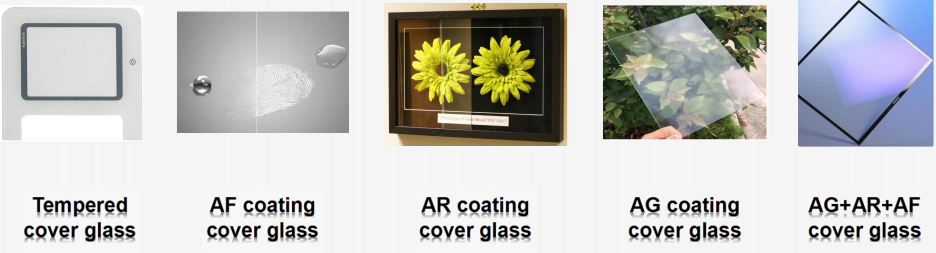
Modern chemical strengthened cover glass often requires additional surface treatments.
Anti-Glare (AG) Coating
Reduces reflections and improves outdoor readability.
Anti-Reflective (AR) Coating
Improves light transmission and reduces surface reflection.
Anti-Fingerprint (AF) Coating
Provides smoother touch feeling and easier cleaning.
Customers should specify:
- Required coating type
- Surface side (front/back)
- Optical requirements
- Durability expectations
AG, AR, and AF coatings can significantly influence optical performance, so the final requirement should match the actual display application. Saiweiglass
7. Printing and Decorative Requirements
Many custom cover glass products include screen printing.
Common requirements include:
- Black border printing
- Logo printing
- Icons
- Transparent windows
- Decorative patterns
When requesting printed cover glass, provide:
- Artwork file
- Color reference
- Printing position
- Ink requirements
- Registration tolerance
For mass production, the printing design should be reviewed together with the glass structure to avoid interference with bonding or display areas.
8. Strengthening Requirements
Cover glass strength can be improved through:
Chemical Strengthening
Common for thin cover glass requiring high strength.
Thermal Tempering
Usually used for thicker glass panels.
The supplier needs to understand:
- Required strength level
- Application environment
- Impact requirements
- Glass thickness limitation
Not every glass type is suitable for every strengthening process.
9. Adhesive and Bonding Information
If the cover glass will be bonded to a display module, provide:
- Adhesive type
- OCA requirements
- Bonding area
- Display structure
- Assembly method
Incorrect bonding information can cause:
- Air bubbles
- Optical defects
- Alignment problems
- Reduced reliability
10. Quality and Inspection Requirements
Quality standards should be discussed before production.
Important inspection requirements may include:
Dimensional Inspection
- Length and width
- Thickness
- Hole position
- Flatness
Optical Inspection
- Transparency
- Haze
- Reflection
- Appearance
Surface Inspection
- Scratches
- Chips
- Particles
- Coating defects
Customers should provide their inspection standards whenever possible.
A clear quality agreement helps avoid misunderstandings during mass production.
Custom Cover Glass RFQ Checklist
Before sending an inquiry, prepare:
| Item | Information Needed |
|---|---|
| Application | Display, HMI, automotive, medical, consumer electronics |
| Material | Aluminosilicate, soda lime, Gorilla Glass, etc. |
| Thickness | Glass thickness and tolerance |
| Drawing | 2D drawing or CAD file |
| Dimensions | Size, holes, slots, corner radius |
| Edge | Polishing, chamfer, CNC machining |
| Printing | Logo, border, artwork |
| Coating | AG, AR, AF requirements |
| Strengthening | Chemical strengthening or tempering |
| Quantity | Prototype and mass production volume |
| Quality | Inspection standard and acceptance criteria |
Why Complete Information Matters
A successful custom cover glass project is not only about selecting the right glass material.
It requires cooperation between:
- Product designers
- Display engineers
- Glass manufacturers
- Quality teams
The earlier technical requirements are clarified, the easier it is to optimize cost, production yield, and product reliability.
At WM Cover Glass, we support OEM customers with customized cover glass solutions including cutting, CNC machining, chemical strengthening, screen printing, AR/AG/AF coatings, ultrasonic cleaning, OCA lamination and quality inspection.
If you have a drawing, sample, or technical specification, our engineering team can review your requirements and recommend a suitable manufacturing solution.