 +86-13925515590
 kleinma@aliyun.com

Chemical Strengthening Glass
We provide chemical strengthening glass processing for custom cover glass used in electronic displays, touchscreens, industrial HMIs, automotive interfaces, consumer electronics and other applications requiring improved surface strength and damage resistance.
Chemical strengthening uses an ion-exchange process to modify the surface layer of glass. Compared with conventional thermal tempering, it can be suitable for thinner glass and complex shapes where maintaining optical quality and dimensional accuracy is important.
Glass material, thickness, dimensions, edge finishing, CNC features, printing and surface treatments can be specified according to customer drawings and application requirements.
What Is Chemical Strengthening Glass?
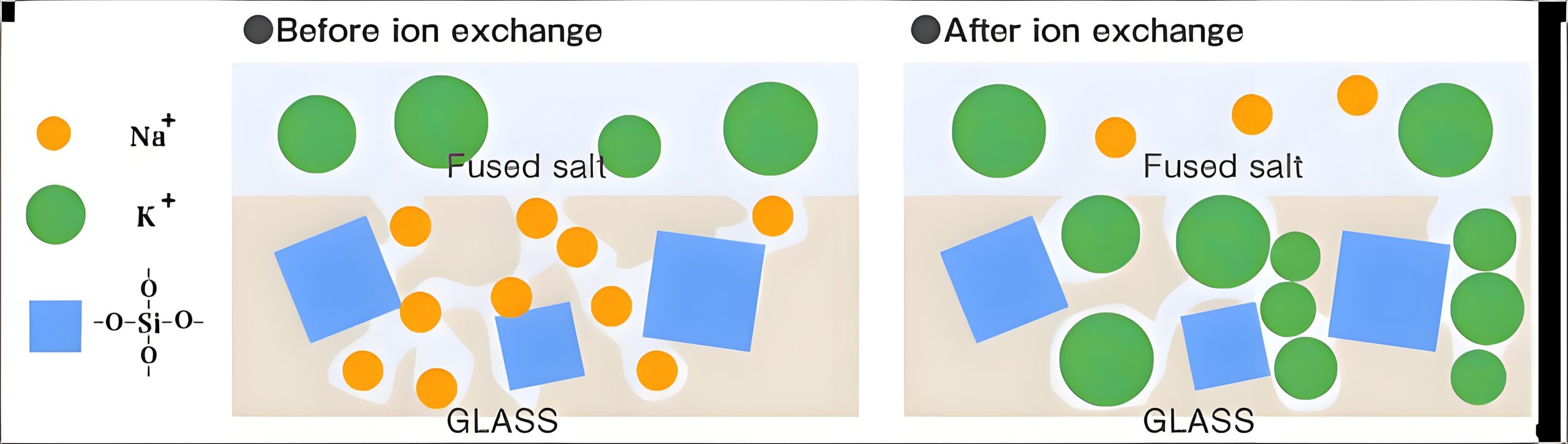
Chemical strengthening is a glass strengthening process based on ion exchange. The glass is treated in a suitable molten salt bath so that smaller ions near the glass surface are exchanged with larger ions.
This process creates a compressive stress layer near the glass surface, helping improve resistance to surface damage and mechanical stress.
The final strengthening parameters depend on the glass composition, thickness, required performance and processing conditions. For OEM projects, strengthening specifications should therefore be confirmed according to the selected glass material and application requirements.
Chemical Strengthening Process
Our chemical strengthening process can be integrated with other cover glass manufacturing operations.
1. Glass Cutting
Glass substrates are cut according to the required dimensions and production drawings.
2. CNC Machining
Precision CNC processing can be used for holes, slots, notches, curved edges and other custom features before the strengthening process where required by the production design.
3. Edge Processing
Edges can be processed according to the required design, including straight, rounded and other specified edge configurations.
4. Chemical Strengthening
The glass undergoes an ion-exchange treatment under controlled processing conditions. The strengthening parameters are determined according to the glass material, thickness and project requirements.
5. Printing and Surface Treatment
After strengthening and other required processes, additional treatments such as silk screen printing, AR, AG or AF coatings can be evaluated according to the final product structure and process sequence.
6. Cleaning and Inspection
Ultrasonic cleaning and quality inspection can be incorporated into the production process to control surface cleanliness, dimensions, appearance and other agreed specifications.
Chemical Strengthening vs Thermal Tempering
Chemical strengthening and thermal tempering are different glass strengthening methods.
Chemical strengthening is based on ion exchange at the glass surface, while thermal tempering uses controlled heating and rapid cooling to create a stress distribution within the glass.
Chemical strengthening can be particularly useful for thin cover glass and applications requiring customized shapes, holes or other precision features. Thermal tempering may be selected for applications where its specific mechanical and production characteristics are more suitable.
The appropriate strengthening method depends on the glass material, thickness, design, application environment and required performance.
Chemical Strengthening for Custom Cover Glass
Chemical strengthening can be combined with custom glass fabrication to produce cover glass according to customer drawings.
Available customization may include:
Custom glass dimensions and thickness
2D and shaped glass designs
CNC holes, slots and cutouts
Edge processing
Silk screen printing
Black borders and functional markings
AR anti-reflective coatings
AG anti-glare treatments
AF anti-fingerprint coatings
Ultrasonic cleaning
Optical and appearance inspection
For projects with complex geometries, the manufacturing sequence should be reviewed before production to determine the appropriate machining and strengthening process.
Glass Materials for Chemical Strengthening
Chemical strengthening is commonly associated with specialty glass compositions designed for ion-exchange treatment.
Depending on the project, suitable glass materials may include aluminosilicate glass and other chemically strengthenable glass substrates.
Material selection should consider:
Glass thickness
Required mechanical performance
Optical requirements
Surface treatment
Application environment
Shape and machining requirements
Production volume
Customers can specify a preferred glass material or provide the required technical performance for engineering evaluation.
Applications
Chemically strengthened glass can be used for:
Touchscreen cover glass
Electronic display cover glass
Industrial HMI panels
Automotive displays
Consumer electronics
Control panels
POS terminals
Household appliance displays
Camera and imaging devices
Outdoor electronic equipment
Quality Inspection
Chemical strengthening is only one part of the overall cover glass manufacturing process. Quality inspection can be performed throughout production according to the agreed product specifications.
Inspection items may include:
Glass dimensions and thickness
Edge condition
Surface appearance
CNC hole and cutout dimensions
Printing position and appearance
Surface cleanliness
Coating requirements
Strengthening-related specifications
Optical requirements where applicable
Inspection criteria can be established from customer drawings, specifications and approved samples before mass production.
Chemical Strengthening for OEM Cover Glass
For OEM projects, we can evaluate the complete glass manufacturing route from substrate selection through machining, strengthening, printing, coating, cleaning and final inspection.
Customers can provide a 2D drawing, 3D file or technical specification for engineering review.
The production process can then be evaluated according to:
Glass material
Thickness
Overall dimensions
Shape and edge design
CNC features
Strengthening requirements
Printing artwork
AR / AG / AF requirements
Prototype quantity
Estimated production volume
Request a Chemical Strengthening Glass Quote
Have a thin or precision cover glass project that requires chemical strengthening?
Send us your drawing and glass requirements for an engineering review.
Please provide:
Glass material or preferred substrate
Glass thickness
Overall dimensions and shape
Holes, slots and CNC features
Edge finishing requirements
Chemical strengthening requirements
Silk screen printing requirements
AR, AG or AF coating requirements
Prototype quantity
Estimated production volume
Our engineering team can review the glass design and proposed processing sequence before quotation and sample production.
Send Your Drawing for a Chemical Strengthening Glass Quote
FAQ
What is chemical strengthening glass?
Chemical strengthening glass is glass that has been strengthened through an ion-exchange process. The treatment creates a compressive stress layer near the glass surface to improve resistance to surface damage and mechanical stress.
What glass can be chemically strengthened?
Suitable glass depends on its chemical composition and the requirements of the strengthening process. Aluminosilicate and other specially formulated glass substrates can be evaluated for chemical strengthening.
Is chemical strengthening suitable for thin cover glass?
Chemical strengthening can be suitable for thin glass applications because the strengthening process does not rely on the same heating and rapid cooling process used for thermal tempering. Final suitability depends on the glass composition, thickness and application requirements.
Can chemically strengthened glass be CNC machined?
Yes. CNC holes, slots, cutouts and other precision features can be incorporated into the manufacturing process. The machining sequence should be determined according to the glass design and strengthening requirements.
Can chemical strengthening be combined with AR, AG and AF coatings?
Yes. Chemical strengthening can be combined with AR, AG and AF surface treatments when the selected materials and production sequence are compatible with the project requirements.
Can you manufacture chemical strengthened cover glass according to drawings?
Yes. Customers can provide drawings or technical specifications covering dimensions, thickness, shape, CNC features, printing, coatings and strengthening requirements for engineering evaluation.