 +86-13925515590
 kleinma@aliyun.com


Glass Edge Finishing: How to Choose the Right Edge for Custom Cover Glass

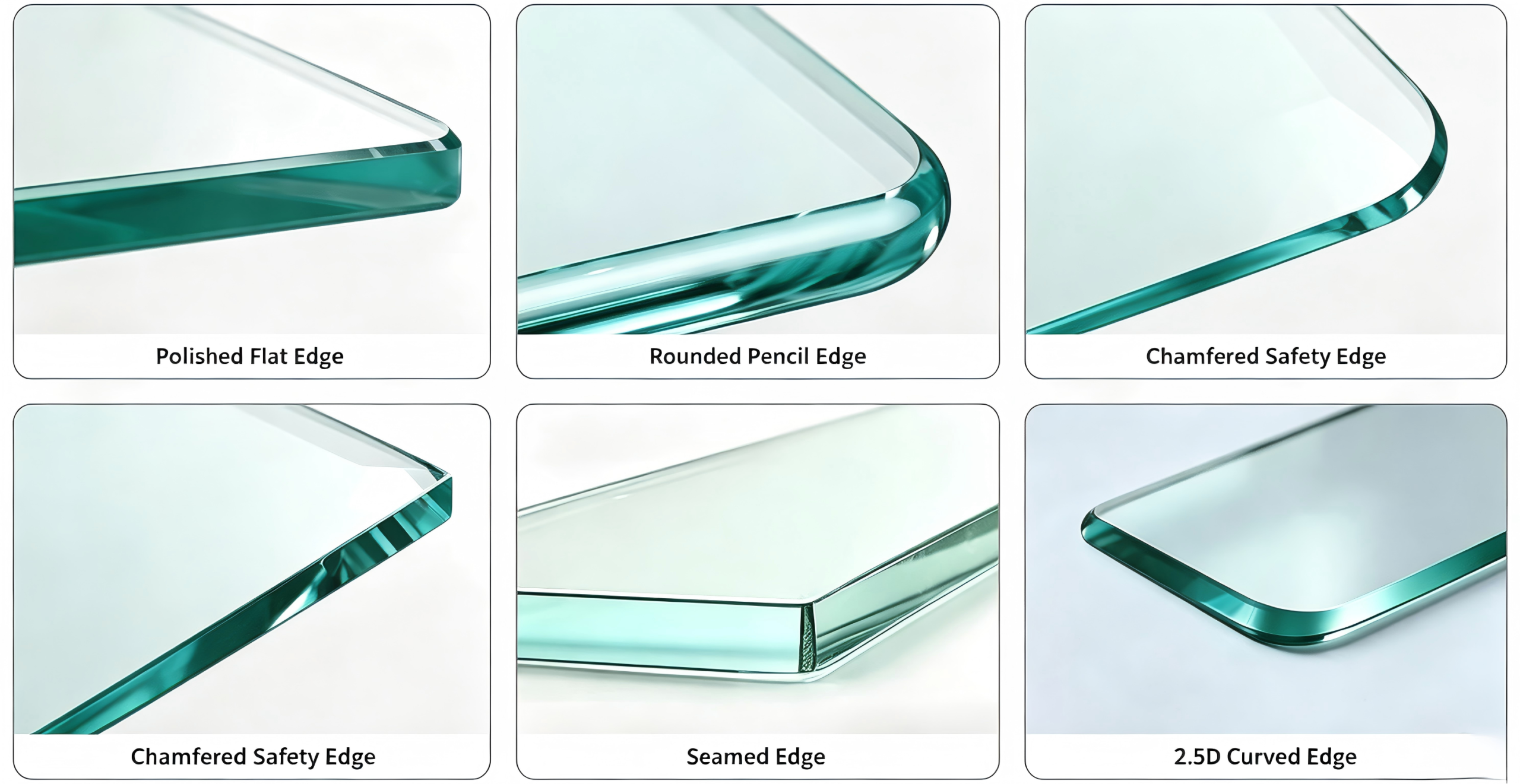
When developing custom cover glass for an electronic device, the edge is often one of the details that receives attention only after the main dimensions, thickness, and surface treatment have been confirmed.
However, glass edge finishing can affect more than appearance. It influences how a glass component is handled, how it fits into an enclosure, how its perimeter looks after assembly, and what inspection requirements should be included in the technical drawing.
For OEM products such as touchscreen panels, industrial control displays, camera windows, and household appliance interfaces, choosing an appropriate edge finish is part of the product design process.
This guide explains common glass edge finishing options, their practical differences, and the information buyers should specify before requesting a quotation.
Why Glass Edge Finishing Matters
Glass is a brittle material. Cutting and machining can leave sharp corners and small defects along the perimeter. Further edge processing is often used to remove sharp areas, refine the edge profile, and achieve the required appearance.
The importance of edge finishing depends on the final application.
For example:
- A cover glass panel installed inside a housing may have concealed edges.
- A touchscreen with an exposed perimeter may require a cleaner, more refined edge.
- A camera cover may need precise dimensions and a consistent edge condition for assembly.
- A decorative appliance control panel may require both a controlled edge profile and a uniform visible finish.
The edge should therefore be evaluated together with the glass thickness, panel geometry, mounting method, and surrounding housing.
Common Types of Glass Edge Finishing
Different suppliers may use slightly different names for similar edge processes. For this reason, buyers should confirm the actual cross-sectional profile and surface appearance rather than relying on an edge name alone.
1. Seamed Edge
A seamed edge is produced by lightly grinding or chamfering the sharp corners along a cut glass edge.
The purpose is mainly to remove sharp arrises and reduce the risk of handling cuts or minor corner damage. The main cut face of the edge is not necessarily ground to a refined finish.
A seamed edge is commonly considered when:
- The glass edge will be hidden inside the product housing.
- The perimeter is not intended to be a visible decorative feature.
- The design requires basic edge treatment rather than a polished appearance.
For electronic cover glass, the drawing should clarify whether seaming is required on both sides and whether the full perimeter must be processed.
2. Ground Edge
A ground edge is produced by abrasive machining to refine the cut edge. Depending on the process and abrasive grade, the result may have a matte or frosted appearance.
Compared with a raw cut edge, grinding provides a more controlled edge surface and can help achieve the required finished dimensions.
Ground edges may be suitable for components where the perimeter is not highly visible or where a polished appearance is unnecessary.
When specifying this finish, buyers should clarify:
- Whether the edge is rough-ground or fine-ground
- Whether the top and bottom arrises are chamfered
- The required finished dimensions
- The acceptable appearance of the ground surface
- Whether chips or unprocessed areas are permitted
The term “ground edge” alone may not define an adequate inspection standard.
3. Flat Polished Edge
A flat polished edge has a flat edge face that is ground and then polished to produce a smoother, more reflective appearance.
It is commonly selected for glass components where the perimeter remains visible or where a refined appearance is important.
Potential applications include:
- Display cover glass
- Touchscreen glass panels
- Consumer electronic interfaces
- Decorative appliance glass
- Visible glass windows and panels
A flat polished edge is not automatically required for every electronic cover glass project. If the perimeter is fully concealed after installation, a simpler edge finish may be more practical.
The drawing should identify the polished edge location, corner treatment, and any visible appearance requirements.
4. Pencil Edge
A pencil edge has a rounded or curved profile rather than a flat edge face. Depending on the required appearance, it may be ground or polished.
This profile can be considered when the product design calls for a softer perimeter shape or when the edge is exposed to users.
However, the achievable radius depends on the glass thickness, geometry, machining equipment, and available processing method.
For thin electronic cover glass, buyers should not assume that every traditional pencil-edge profile can be applied without design adjustments. The profile should be reviewed against the actual glass dimensions and thickness.
5. Beveled Edge
A beveled edge has an angled surface along the perimeter. The bevel can be designed for decorative purposes or to meet a particular product geometry.
Important drawing details include:
- Bevel angle
- Bevel width
- Bevel location
- Whether the bevel is polished or ground
- Corner transitions
- Finished overall dimensions
Beveled edges are more design-specific than basic seaming or flat grinding. Their feasibility should be reviewed before the sample stage, especially for thin or irregularly shaped glass.
Glass Edge Finishing Comparison
| Edge Type | Appearance | Typical Consideration |
|---|---|---|
| Seamed edge | Sharp corners removed; cut face remains | Concealed edges and basic handling |
| Ground edge | Matte or frosted edge surface | Functional edge finishing |
| Flat polished edge | Flat, smooth, reflective edge | Visible display and decorative edges |
| Pencil edge | Rounded edge profile | Exposed edges requiring a curved profile |
| Beveled edge | Angled perimeter surface | Decorative or design-specific requirements |
The most suitable option depends on the product structure. A more elaborate finish is not necessarily a better choice for every application.
How to Specify Glass Edge Finishing in an OEM Drawing
One of the common causes of disagreement between buyers and manufacturers is an incomplete edge specification.
A drawing that only states “polished edge” may leave questions about the exact profile, corner treatment, and inspection criteria.
For a custom cover glass project, consider including the following information.
1. Define the Edge Profile
Show the required cross-section or provide a clear technical reference.
If the design uses a flat polished, pencil, or beveled edge, include a profile drawing whenever possible.
2. Identify Which Edges Need Processing
Not every side of a glass component necessarily requires the same treatment.
Mark the processed edges clearly on the drawing. For example, all four sides may require polishing, while a particular mounting edge may use a different finish.
3. Specify Corner Treatment
The corners may require a defined radius, chamfer, or other geometry.
Do not assume that corner treatment is automatically included in the edge-finish description.
4. Confirm Finished Dimensions
Edge grinding removes material. The drawing should make clear whether the specified length and width refer to the final processed dimensions.
This is particularly important when the glass must fit into a tight enclosure or align with a display module.
5. Define Appearance Requirements
If the edge is visible after assembly, specify the required appearance and acceptable surface condition.
Reference samples or photographs can help clarify expectations, but they should be accompanied by written requirements.
6. Consider the Complete Manufacturing Process
Edge finishing should be reviewed together with cutting, CNC machining, drilling, strengthening, printing, and other required processes.
The processing sequence may affect the final appearance and dimensional requirements. It should be confirmed with the manufacturer before production.
Does a Polished Edge Always Mean Stronger Glass?
Not necessarily.
A polished edge can provide a smoother and more refined appearance, but visual quality alone does not establish the mechanical strength of a glass component.
The strength of a glass edge can be influenced by machining-induced flaws, edge geometry, material characteristics, processing conditions, and the loads applied during use.
Research on glass edge grinding and polishing has also shown that edge strength can vary with manufacturing processes. It should not be assumed that an edge with a better visual finish will always have higher mechanical strength.
For projects with specific mechanical or safety requirements, buyers should define the relevant performance criteria and discuss appropriate verification methods with the manufacturer.
Edge finishing should also be considered together with the selected strengthening process. Chemical strengthening and thermal tempering have different material and geometry requirements, so the complete design should be evaluated before confirming the production route.
How to Choose the Right Edge for Different Cover Glass Applications
The following examples can help narrow down the initial specification.
Display and Touchscreen Cover Glass
For display cover glass, the choice depends on whether the perimeter is visible, how the panel is mounted, and how closely it must fit the display housing.
Flat polished or ground edges may be considered depending on the design and appearance requirements.
Industrial Control Panel Glass
Industrial panels often have mounting structures, cutouts, and defined enclosure dimensions.
Dimensional accuracy, corner geometry, and edge condition should be reviewed together. A decorative edge profile may not be necessary when the perimeter is fully concealed.
Camera Cover Glass
Camera cover glass may have compact dimensions and specific mounting requirements.
The edge profile should be selected according to the assembly structure, while dimensional consistency and surface cleanliness remain important inspection considerations.
Household Appliance Glass
For appliance control panels and decorative glass interfaces, the perimeter may be visible to the end user.
The selected finish should balance appearance, assembly requirements, and manufacturing feasibility.
What Should You Send to a Cover Glass Manufacturer?
To evaluate an edge-finishing requirement, provide as much of the following information as possible:
- Glass material and thickness
- Overall dimensions
- 2D technical drawing or 3D file
- Required edge profile
- Edge processing locations
- Corner radius or chamfer requirements
- Dimensional tolerances
- Surface treatment and printing requirements
- Estimated sample and production quantities
- Intended application and mounting method
If the edge profile has not yet been finalized, a drawing showing the glass installation structure can help the manufacturer review possible options.
Custom Cover Glass Manufacturing at WM Cover Glass
WM Cover Glass provides OEM glass processing based on customer drawings, samples, and project specifications.
Our manufacturing capabilities include glass cutting, CNC grinding and drilling, chemical strengthening, thermal tempering, silk screen printing, AR/AG/AF coatings, ultrasonic cleaning, and adhesive bonding or OCA lamination.
For custom display glass, touchscreen panels, industrial control interfaces, camera glass, and household appliance glass, edge requirements can be reviewed together with dimensions, thickness, machining features, and the intended assembly structure.
A clear edge specification helps reduce misunderstandings during sampling and supports more consistent inspection before mass production.
Have a custom cover glass drawing?
Send us your drawing, sample, or preliminary specifications. We can review the edge profile, dimensions, machining requirements, and related processing needs for your OEM project.