 +86-13925515590
 kleinma@aliyun.com

Blog
A Guide To Tell Difference Between AG, AR, AF Coatings In 9H High Quality Cover Glass Industry

What’s Coatings In Cover Glass?
When a new display project or solution launching, the egineers and design teams usually meet light reflection issues and need to purchase suitable coatings in cover glass. When buyers and engineers are new to optical glass, the coatings in cover glass industry terms aren’t familiar. Possibly they will search vague keywords like “anti reflection glass” or “non glare glass“, which leads to ambiguous communication with glass OEM.
So let’s focus on the principles, applications and identification methods of AG, AR and AF coatings in cover glass to help you quickly tell their differences and locate the correct OEM.

First, AG Glass(Anti glare glass), also known as non glare coatings in cover glass
Definition
Under chemical etching or spraying, the mirror smooth glass surface transformed into a matte texture with tiny uneven particles. The adjusted surface roughness diffuses incident light to achieve anti-glare effects.
AG treatment can be applied on single or double sides of glass. The AG matte side must face outwards during assembly. Lower gloss delivers better light diffusion and less harsh glare.
Functions & Applications
The AG scatters ambient reflected light to eliminate dazzling glare and deliver comfortable view experience, it widely used for displays which expose to strong sunlight or bright environments: Outdoor machine screens, ATM machines, POS terminals, medical B-ultrasound monitors, E-readers, gas station displays, subway ticket validator screen etc.
Quick identification method
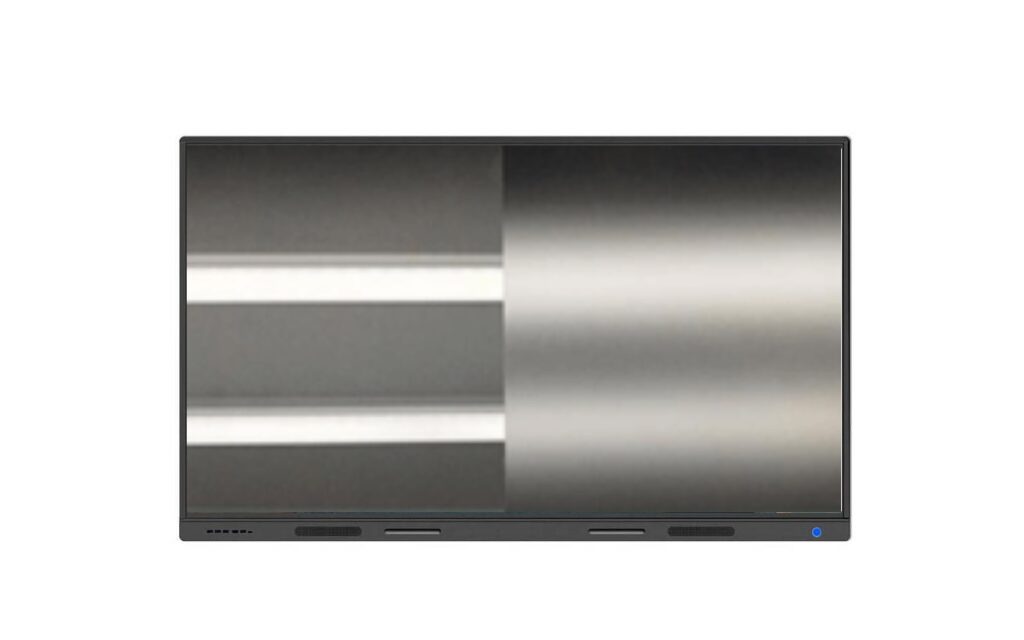
Place the glass under a fluorescent lamp and observe the lamp reflection from front:
Blurred, scattered lamp refletion=AG treated surface
Clear, sharp lamp mirror image=Untreated smooth surface
Non AG VS. AG
Second, AR Glass(Anti reflection glass), also know as high transmittance glass
Definition

AR coating can be overlaid on AG matte glass for combined anti-glare and high-transmittance performance.
Third: AF Coating (Anti-Fingerprint Coating)
Definition
Inspired by the lotus leaf effect, a nano fluorochemical layer coated on glass to form hydrophobic and oleophobic surfaces.
AF coating is only applied on one side as the outermost touch surface.
Functions
1.Fingerprints, oil stains and water spots can be wiped off effortlessly.
2.Smoother sliding touch feeling with lower friction.
Applications
All touchscreen cover glass including mobile phones, tablets, vehicle central control screens, medical devices, industrial touch panels and smart home touch displays.
Composite Processing Combinations
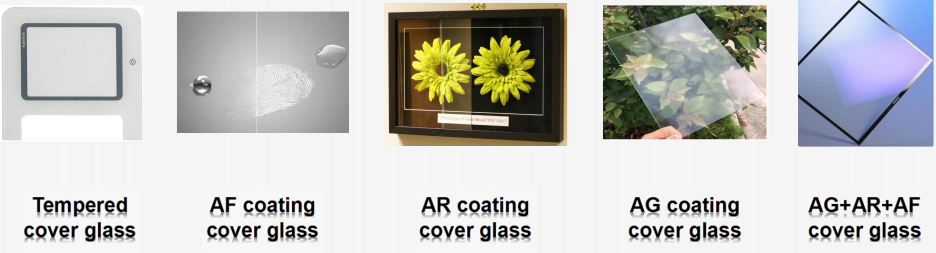
Multiple treatments can be stacked: AG+AF, AR+AF, AG+AR+AF (3A full-function glass)
Quick Identification Methods
Water drop test: Water beads up and rolls freely without spreading on AF-coated surface. And test the water drop angle.
Oil pen test: Oil ink cannot adhere firmly and wipes away easily on AF coating.

Coatings In Cover Glass Core Differences Summary
AG: Matte textured surface, scatters harsh ambient light for outdoor anti-glare use
AR: Optical film to maximize light transmission, delivers ultra-clear indoor visuals
AF: Nano hydrophobic-oleophobic coating, prevents fingerprints for touch screens
Selection Tips
Outdoor / high-brightness viewing environment: Choose AG coatings in cover glass
Indoor scenes requiring high definition and minimal light loss: Choose AR coatings in cover glass
Frequently touched panels prone to fingerprints: AF coating is mandatory
Outdoor high-definition touch devices: Adopt triple treatment AG+AR+AF coatings in cover glass